

Fig Trees Have Good Bones
How to kill your ego and let Sylvia out of your garden.

“I saw my life branching out before me like the green fig tree in the story. From the tip of every branch, like a fat purple fig, a wonderful future beckoned and winked. One fig was a husband and a happy home and children, and another fig was a famous poet and another fig was a brilliant professor, and another fig was Ee Gee, the amazing editor, and another fig was Europe and Africa and South America, and another fig was Constantin and Socrates and Attila and a pack of other lovers with queer names and offbeat professions, and another fig was an Olympic lady crew champion, and beyond and above these figs were many more figs I couldn’t quite make out. I saw myself sitting in the crotch of this fig tree, starving to death, just because I couldn’t make up my mind which of the figs I would choose. I wanted each and every one of them, but choosing one meant losing all the rest, and, as I sat there, unable to decide, the figs began to wrinkle and go black, and, one by one, they plopped to the ground at my feet.”
- Sylvia Plath, The Bell Jar

In the summer of 2020, I did what every angsty English major must do at some point in her life: I sat underneath a lilac bush and read The Bell Jar.
The Bell Jar is infamously depressing. In hindsight, would I recommend it to a 19-year-old girl during a global pandemic? Nope! But despite its depressing themes and bleak prose, when I read Plath’s fig tree allegory, an odd sense of relief washed over me. Someone understood. Someone else, years before I was alive, had the same vast, insatiable hunger for life as me—and it scared her too.
That was six years ago. If you haven’t crunched the numbers yet, allow me to do the honors: I’m a few days away from turning 26. This time next week, I’ll officially be too old for Leonardo DiCaprio and my parent’s health insurance.
Even though I love blowing out candles, birthdays always bring me a sense of urgency. Have I done enough? Am I on the right path? Where will I be this time next year?
And, because I was once that angsty English major with a tattered copy of The Bell Jar in her hands, these worries take the shape of broad branches, towering trees, and ripe figs at my feet.
I want this year to be different. I no longer want to find solace in shared fears. I no longer want to commiserate and be comfortable with my worries; I want to release them.
Why am I so scared of watching wonderful futures plop down around me, wrinkling and rotting? Why do I want all these figs for myself? This year, I’m trying to reimagine Plath’s fig tree. I’m trying to make peace with her prose.
Here are the three lessons I’ve learned from unlearning Plath’s fig tree.
You cannot eat every fig alone. Kill your ego and throw a garden party.
Let’s start with the bad news: Plath is right. You cannot eat every fig.
You cannot be a pop star and a surgeon and a museum curator and a model and a photographer and an astronaut. You cannot have an endlessly parade of love affairs and a familiar pair of warm arms to come home to. You cannot be in South America and Europe and Africa all at once; you cannot build a home without living in it.
You can’t be the center of attention at every party. You can’t be everyone’s best friend. You can’t be everything, to everyone, always.
You will disappoint the wide-eyed teenager you once were, the one who wanted to grow up and taste everything.
So of course, it’s natural to fear the fig tree, to stand beneath its heavy branches and feel undone by all the fruit you cannot have.
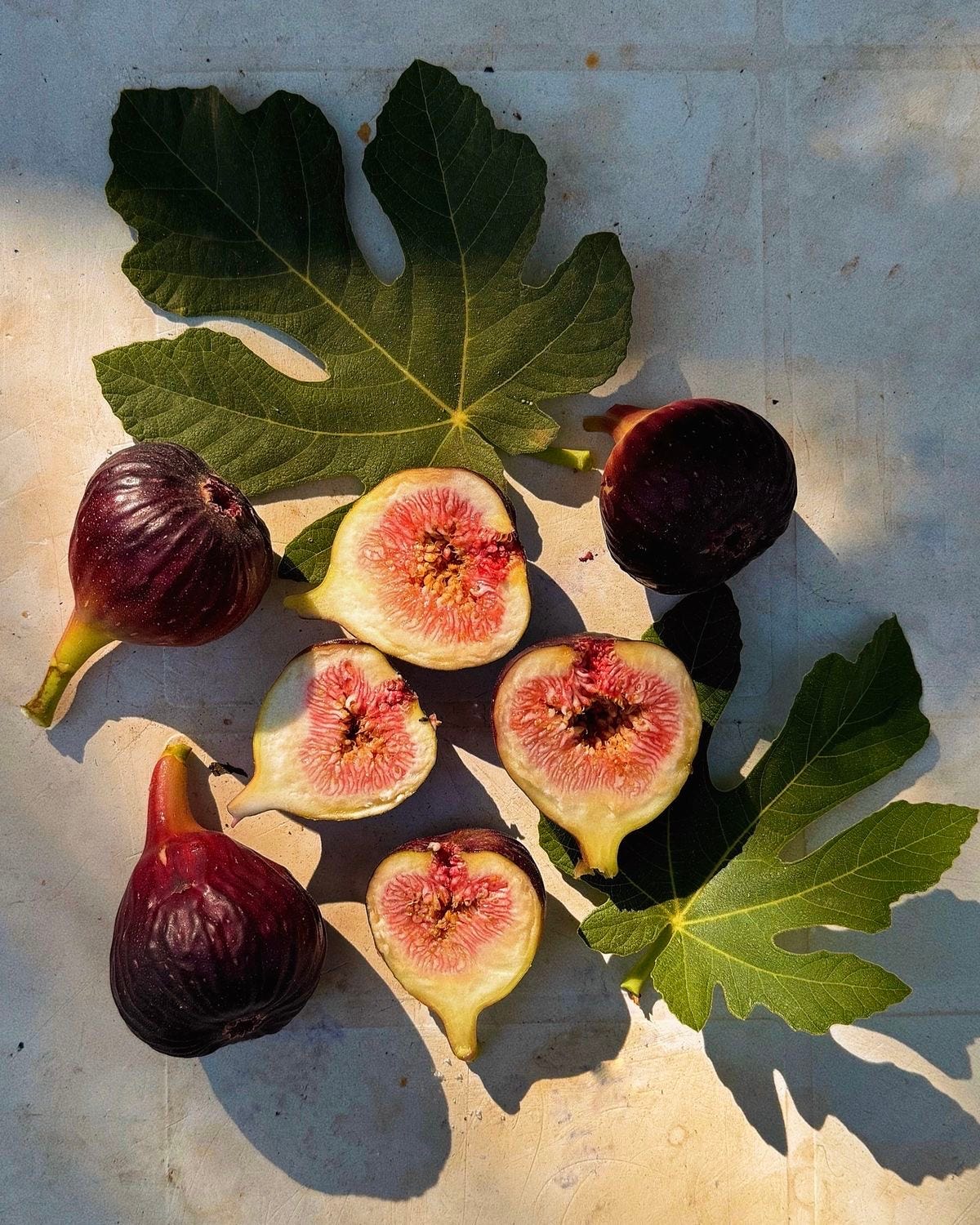
But here is the good news: those figs will rot.
The problem is not the relentless march of time. It’s not the abundance of figs or the size of your stomach. It’s not even your inability to just pick a damn fig already.
The problem is sitting beneath the tree alone, thinking the only way to savor its fruit is to eat it by yourself. It’s your ego telling you that the only way to appreciate something is to own it.
The world needs every type of person, every type of artist, every type of life. What if instead of coveting these experiences, lamenting the fact that we can’t live them all, we celebrated those who are lucky enough have them? If you can’t be rich in figs, be rich in friends.
I’m not a musician, but I have friends who are. I get to sway in the crowd at their shows and sing along to their music.
I’m not a chef, but I have friends who invite me over for crêpes in the morning and host supper clubs.
I’m not a photographer, but I get to see the world through the lenses of my friends who make a living capturing memories.
These bright futures that once winked at me are not lost, they’re alive and well inside of other people. In loving them, I get to see these beautiful lives play out. By supporting their work, I nourish the part of myself that once longed for that fig.
I can find joy in seeing other people thrive. I can find purpose in sharing fruit.
Fig trees are resilient. Your harvest is not lost.
Yes, fig season is short, and yes, the fruits spoil quickly. But the lifespan of the fruit bears no resemblance to the tree. Fig trees can survive extreme freezes, long droughts, sudden floods.
Even if a fig tree is cut to the ground, it will not die. Its roots are too strong, its desire to live too powerful. Within weeks, new shoots will rise up from the stump. The sapling will return.
You can’t eat every fig, but the tree is strong. Your harvest is never truly lost.
Each season of life brings a new plethora of fruit, a new abundance of futures to wish for. The fig tree I sat under at 19 bore very different fruit than the one I sit under now. How lucky am I to have grown and changed, to let the passage of time rewire my tastebuds? To no longer crave the things I thought I couldn’t live without?
Of course, a good life requires a degree of urgency; you have to feel the fruit squish between your toes sometimes. It has to scare you, just a little, to think of wasting precious moments. You have to worry about time running out, just enough to propel you forward.
But life is bigger than the figs you couldn’t eat.
Some figs will fall and some will rot, but I am not the fruit at my feet. I am the tree, and I will always bear more.
When in doubt, make jam.
Like most kids, I dreamt of a kaleidoscope of careers. At eight years old, my figs were shaped like astronauts, pop stars, veterinarians, mothers, and doctors. They looked like distant mountains and vast oceans.
My tree has changed; my figs have evolved. Now that I’m an adult, I have no desire to squeeze into a rocket ship and be launched into space, or sing in front of anyone with functioning ear drums.
But on a clear, moonless night, I love to look at the stars and search for constellations. I love to read about the James Webb Telescope and the Fermi paradox.
I love to sing in the car and the shower. Once in a blue moon, I’ll get tipsy at a karaoke bar and sing for my friends.
If I wanted to be cynical, I could say these are futures I lost, these are figs I let rot. But what if there is more than one way to savor this fruit? What if I didn’t leave these figs behind, but I gathered them up, brought them home, and made jam? The version of myself who once dreamt of these lives isn’t gone, she’s preserved in every small hobby, interest, and habit.
Every small detail that makes me me is evidence that I once held those figs. They’re not wasted, they’re lined up on the shelves of my pantry in jam jars, waiting patiently for me to remember them and savor their sweetness.
Anyways.
This year, I’ll spread a blanket beneath the fig tree. I will make room for everyone. We’ll feel the sun on our faces, the breeze on our skin. I won’t look up at the branches or count the figs beyond my reach. I’ll look at the people around me. Watch fruit fall into their laps, see their faces light up, and be happy for them. The right figs will land on me; the ones I can’t reach belong to someone else.
May next season bring us even more fruit. May shelves of our pantries always be lined with jam jars.
This was lovely!
katie, you’re rewiring my brain chemistry with this one <333